Drug & Supplies Inventory
What a clinic drug label must carry: the 8 legally required items, a sample label, and how to get every one right
Since 17 March 2024, every drug label a Thai clinic hands to a patient must carry 8 items set by the Ministry of Public Health. In a survey of 89 clinics, only 3 had them all. This guide covers what the items are, what a compliant label looks like, and how to get there without adding work at the counter.
Published Updated 12 min read
The short answer
- A label on medicine a clinic dispenses for the patient to take home must carry 8 items, under the Ministry of Public Health Notification on Standards of Service of Sanatoriums Regarding Drug Labelling, B.E. 2565 (2022).
- It applies to every non-overnight healthcare facility — general medical clinics, specialty clinics (dermatology and aesthetic clinics included), nursing clinics — and has been fully in force since 17 March 2024.
- The 8 items: clinic name and contact · patient's full name, HN and dispensing date · drug name · dosage form, strength and quantity · directions · indication · warnings or precautions · expiry date.
- The law says what must be on the label, not whether it is printed or handwritten — but the survey shows handwritten labels almost never make it, because half the items are drug-level facts the person writing does not have in front of them.
- The way to get every label right is to split the data into 3 layers — clinic, drug, visit — and have each layer entered once, at the point where that data actually lives.
01The rule: which notification, who it covers, when it took effect
Until recently there was no itemised requirement for clinic drug labels, so clinics did what they had always done — many used pre-printed envelopes with room for only a drug name and directions. That changed when the Ministry of Public Health issued the Notification on Standards of Service of Sanatoriums Regarding Drug Labelling, B.E. 2565, under the Sanatorium Act B.E. 2541, published in the Royal Gazette on 16 March 2022.
The notification allowed a two-year transition, so it has been fully enforceable since 17 March 2024. In practice that means the officers who inspect clinics under the Sanatorium Act — typically provincial public health office staff — can now check labels against this list, and the study cited in this guide collected its data by having exactly those officers inspect real labels.
Which clinics it covers
- General medical clinics and specialty medical clinics — dermatology, aesthetic and surgical clinics all sit here.
- Other non-overnight facilities too, such as dental clinics and nursing and midwifery clinics — the Thailand Nursing and Midwifery Council issued a notice telling its members to comply with this notification specifically.
- Not pharmacies — they fall under the Drug Act and have their own labelling rules.
02The 8 items a drug label must carry
The notification lists 8 items. This table summarises each one with a correctly written example and the mistake clinics most often make — the examples and mistakes are observations from real label inspections, not part of the notification.
#1
- Item in the notification
- Clinic name and telephone number or contact channel
- Correct example
- Pornpimol Medical Clinic · 02-123-4567
- Common mistake
- A logo with no phone number, or old envelopes printed with another branch's name
#2
- Item in the notification
- Patient's first and last name, patient number (HN), and dispensing date
- Correct example
- Ms. Kamonwan Jaidee · HN 004512 · 3 Sep 2026
- Common mistake
- Name without HN, a nickname, or no date
#3
- Item in the notification
- Drug name
- Correct example
- Amoxicillin
- Common mistake
- Abbreviations or in-house nicknames like "the anti-inflammatory" that nobody else can identify
#4
- Item in the notification
- Dosage form, strength, and quantity dispensed
- Correct example
- Capsule 500 mg · 15 capsules
- Common mistake
- The most frequently missing item — pre-printed envelopes have no box for it
#5
- Item in the notification
- Directions for use
- Correct example
- Take 1 capsule 3 times a day after breakfast, lunch and dinner
- Common mistake
- "As directed by the doctor" with no dose or timing
#6
- Item in the notification
- Indication
- Correct example
- To prevent infection after the procedure
- Common mistake
- Left out because "the patient knows what they came for"
#7
- Item in the notification
- Warnings, precautions, or contraindications
- Correct example
- Finish the course. Stop and contact the clinic immediately if you get a rash or trouble breathing
- Common mistake
- A generic warning that does not match the drug, or none at all
#8
- Item in the notification
- Expiry date of the drug
- Correct example
- EXP 12/2027
- Common mistake
- "See box" — the box stays at the clinic and never goes home with the patient
03What a label with all 8 items looks like
Below is a label for a post-procedure antibiotic. The numbered markers show which item in the table each part answers. Use it as a template — change the clinic and drug details and you are done.
Pornpimol Medical Clinic
- Contact
- Tel 02-123-4567 · LINE @pornpimol
- Patient · HN · Dispensed
- Ms. Kamonwan Jaidee · HN 004512 · 3 Sep 2026
- Drug
- Amoxicillin
- Form · Strength · Quantity
- Capsule 500 mg · 15 capsules
- Directions
- Take 1 capsule 3 times a day after breakfast, lunch and dinner
- Indication
- To prevent infection after the procedure
- Warning
- Finish all 5 days. Stop and contact the clinic immediately if you get a rash, itching or trouble breathing
- Expiry
- EXP 12/2027 · Lot A2405
Dispensed by Sudarat, RPh · Printed 3 Sep 2026 14:32
04Most clinics still fall short, and it's the same items every time
A study published in the Thai Journal of Pharmacy Practice in early 2025 surveyed 89 medical clinics in Mueang district, Udon Thani, between July 2022 and July 2023, collecting the labels actually handed to patients. Only 3 clinics (3.4%) had fully compliant labels, and only 11 (12.4%) had all the essential components. The median label carried 4 of the 8 items.
| Item on the label | Clinics that had it |
|---|---|
| Directions for use | 89.9% |
| Clinic name and contact | 82.0% |
| Expiry date | 57.3% |
| Drug name in English | 56.2% |
| Patient's name and dispensing date | 46.1% |
| Indication | 41.6% |
| Warnings, precautions or contraindications | 31.5% |
| Dosage form, strength and quantity | 13.5% |
| Drug name in Thai | 10.1% |
Notice the pattern. The items clinics get right are the ones the person at the counter already knows at the moment of writing — the directions the doctor just gave, the clinic name printed on the envelope. The items that go missing are drug-level facts — strength, form, indication, warnings — which require opening the box or the package insert. Someone handwriting labels during a long queue skips them without noticing.
The same study found 56.2% of clinics still handwrite labels, 22.5% print from a system, and 21.3% do both. It also found that clinic staff and inspectors, assessing the same label, disagreed on almost every item. Many clinics believe they are compliant while an inspector sees gaps — which is why you should audit against the 8-item list itself, not against a feeling.
05Getting every label right without adding work at the counter
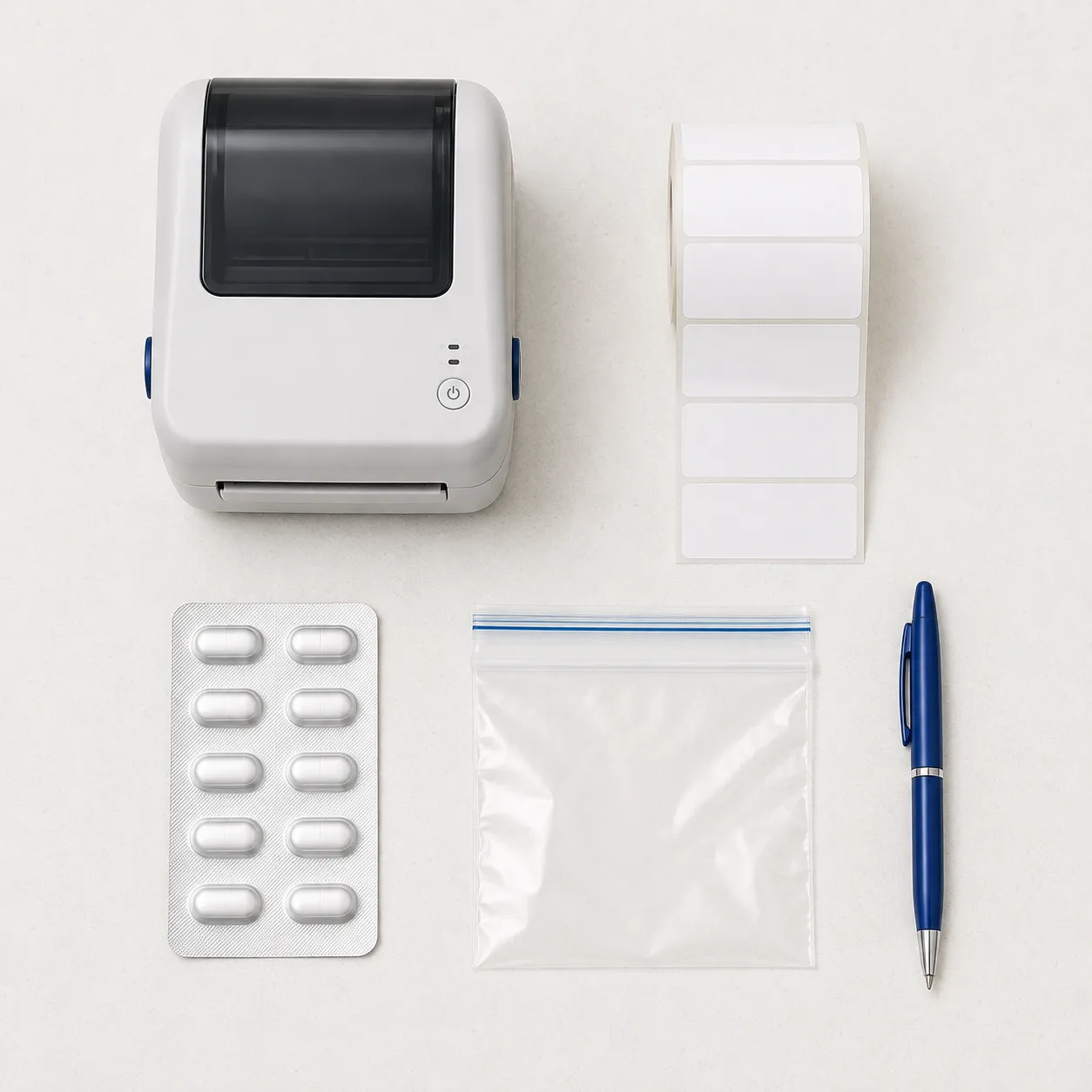
The key is to split label data into 3 layers and have each layer entered once, at the point where the data actually lives. Front-desk staff should not need to know the strength of every drug, and a doctor should not type the clinic's phone number on every visit.
LayerClinic
- Covers items
- 1
- Entered when
- Once, at system setup
- Entered by
- Owner or manager
LayerDrug
- Covers items
- 3 · 4 (form, strength) · 6 · 7 · default directions
- Entered when
- Once per drug, when it enters stock
- Entered by
- The pharmacist or nurse who manages stock
LayerVisit
- Covers items
- 2 · 4 (quantity) · 5 (when it differs from the default) · 8
- Entered when
- Every dispense — from the actual stock deduction
- Entered by
- Pulled by the system; staff only check
Give every drug in your register 5 fields
Generic name (with the Thai name) · form and strength · the indication you use it for most · the drug's standard warning · default directions. Done once when the drug enters stock. Most aesthetic clinics dispense only a few dozen drugs regularly; it takes under half a day.
Set the clinic-level header once
The licensed clinic name, a phone number someone actually answers, and any other contact channel. If you have several branches, the label should pull the dispensing branch's name and number, not head office's.
Pull visit-level data from the stock deduction, never retype it
Name, HN, date and quantity must come straight from the dispense line in that visit. Typing the same data in two places is where wrong-patient and wrong-quantity labels come from.
Take the expiry date from the lot actually deducted
If stock is tracked by lot with an expiry date, and the earliest-expiring lot is deducted first, the expiry on the label is always right without anyone walking over to check the box.
Let the doctor edit only what differs from the default
Default directions and warnings are filled in first; the doctor changes them only for the visits that need it — a different frequency, an extra patient-specific warning.
Print at the point of dispensing and keep a copy on the visit
The printed label should be stored with the visit record. When an inspector asks, or a patient calls, you can see exactly what the label they were given said.
Spot-check once a month
Take the 10 most recent labels and run them against the checklist below. It takes about ten minutes. If the same item keeps going missing, the drug register entry is incomplete — it is not a careless staff member.
06Common mistakes
- Pre-printed envelopes designed before the notification — with boxes only for drug name and directions, no amount of care will get you to 8. Check the envelopes you use first.
- Writing "see box" in the expiry field — the box stays at the clinic; the patient goes home with an envelope that has no expiry date.
- Leaving out the HN — a name alone does not satisfy item 2, and when two patients share a name you cannot trace the visit.
- One generic warning for every drug — "keep out of reach of children" on its own is not a drug warning. Item 7 wants a warning specific to that drug.
- Changing the quantity in the system after the label printed — the label says 15, the record says 10, and it surfaces when an inspector compares the two. Reprint every time you edit.
- Forgetting topicals and repackaged items — a cream decanted from a large bottle into a small jar for the patient is still a drug leaving the clinic, and it is often overlooked because it "doesn't feel like real medicine".
07Self-audit checklist
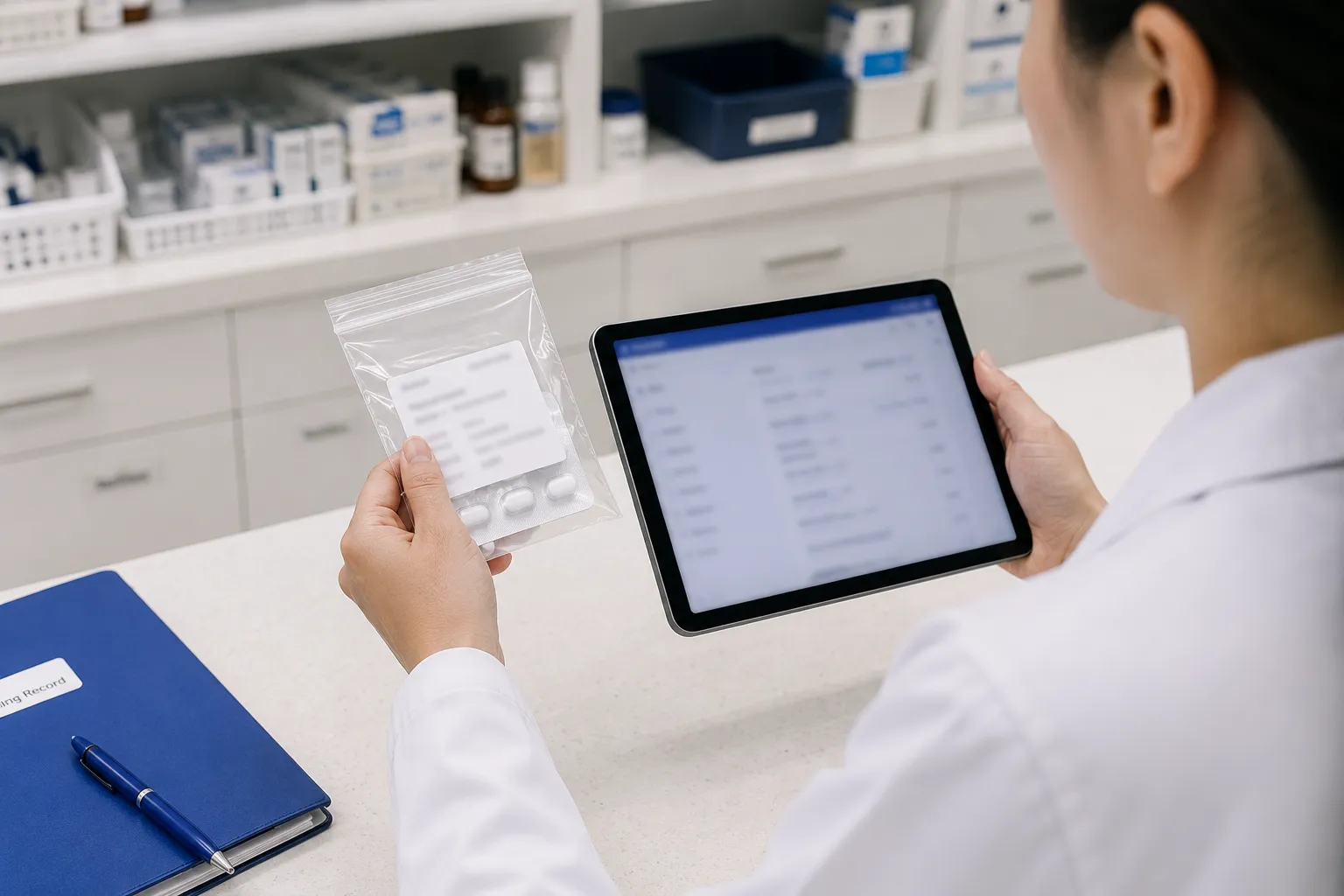
Print this section and keep it at the dispensing point, or use it for the monthly spot-check. A passing label ticks every box.
- Clinic name, and a phone number or contact channel that actually answers
- Patient's full name, HN, and dispensing date
- A drug name someone outside the clinic could identify — not an in-house nickname
- Dosage form, strength, and the quantity actually dispensed
- Directions with a dose, a frequency, and a time
- Indication — what it was dispensed for
- A warning or precaution that matches this drug
- An expiry date copied from the real lot — not "see box"
- Legible without guessing, and does not smudge when wet
- Matches what is recorded in the chart and the stock deduction
- Topicals, repackaged items and liquids are labelled as fully as tablets
In Flow Clinic
All three layers in one place
Flow Clinic keeps the drug register with Thai and English names, stock in lots with expiry dates, and dispense lines tied to the patient and HN inside the same visit. Clinic-level, drug-level and visit-level data live in one system, so nothing is typed twice.
- Product labels print straight from the inventory module, with a choice of Thai name, English name, product code and clinic code.
- The visit's dispense section records post-care instructions and the follow-up date against the patient, so they can be looked up at any time.
- Items below their reorder point appear on a reorder worksheet, where a person reviews them and confirms draft purchase orders from the same screen.
Sources
- Ministry of Public Health Notification on Standards of Service of Sanatoriums Regarding Drug Labelling, B.E. 2565 — Bureau of Sanatorium and Art of Healing, Department of Health Service Support (Thai)
- Characteristics of Drug Labels in Private Medical Clinics: A Cross-sectional Study in Mueang District, Udon Thani — Thai Journal of Pharmacy Practice, Vol. 17 No. 1 (Jan–Mar 2025)
- Notice to all nursing and midwifery clinics to prepare drug labels to the Ministry standard — Thailand Nursing and Midwifery Council (Thai)
Frequently asked questions
- Does the law require printed labels, or is handwriting allowed?
- The notification says what a label must contain, not how it is produced, so handwriting is not a violation. But the survey shows the items that go missing are drug-level facts the writer does not have in front of them, so printing from a system with the drug register filled in is far more reliably complete.
- Does the drug name have to be in Thai?
- The notification simply says "drug name". The safest reading is the English generic name with the Thai name or transliteration alongside, as in the sample above, so the patient and any other doctor or pharmacist identify the same drug. If in doubt, ask your provincial public health office.
- Do drugs used during a procedure and consumed at the clinic need the 8-item label?
- The notification concerns labels on drugs dispensed for the patient to take away from the facility. Drugs used during a procedure and never handed over are not what the 8-item label is for — but what was used, which lot, and how much still belong in the chart.
- Do skincare and cosmeceuticals sold by the clinic need this label?
- If the product is registered as a cosmetic rather than a drug, it is outside this notification — cosmetics carry their own legally required labelling on the packaging. Topicals registered as drugs, such as tretinoin, hydroquinone or steroids, are fully covered. Many clinics label everything the same way to remove the question of which items need it.
- Can we add a logo or extra text to the label?
- Yes, as long as all 8 items remain present and legible. You can rearrange, add a logo, or add post-procedure advice. The thing to watch is extra text crowding the label until the legally required items have to shrink.
- If a patient loses the label, can we issue a new one?
- Yes — and it should be reprinted from the original dispense line in the visit, not rewritten from memory, so the quantity and date match the chart. This is the reason to keep a copy of every label with the visit.